Why Net 30 Accounts Are the Starting Line for Business Credit
Net 30 vendor accounts are one of the fastest ways to build business credit from scratch. If your business is new and you have no credit history, net 30 accounts give you a way to establish payment records that lenders, banks, and credit bureaus can verify. They are the foundation that everything else — business credit cards, lines of credit, and SBA loans — gets built on.
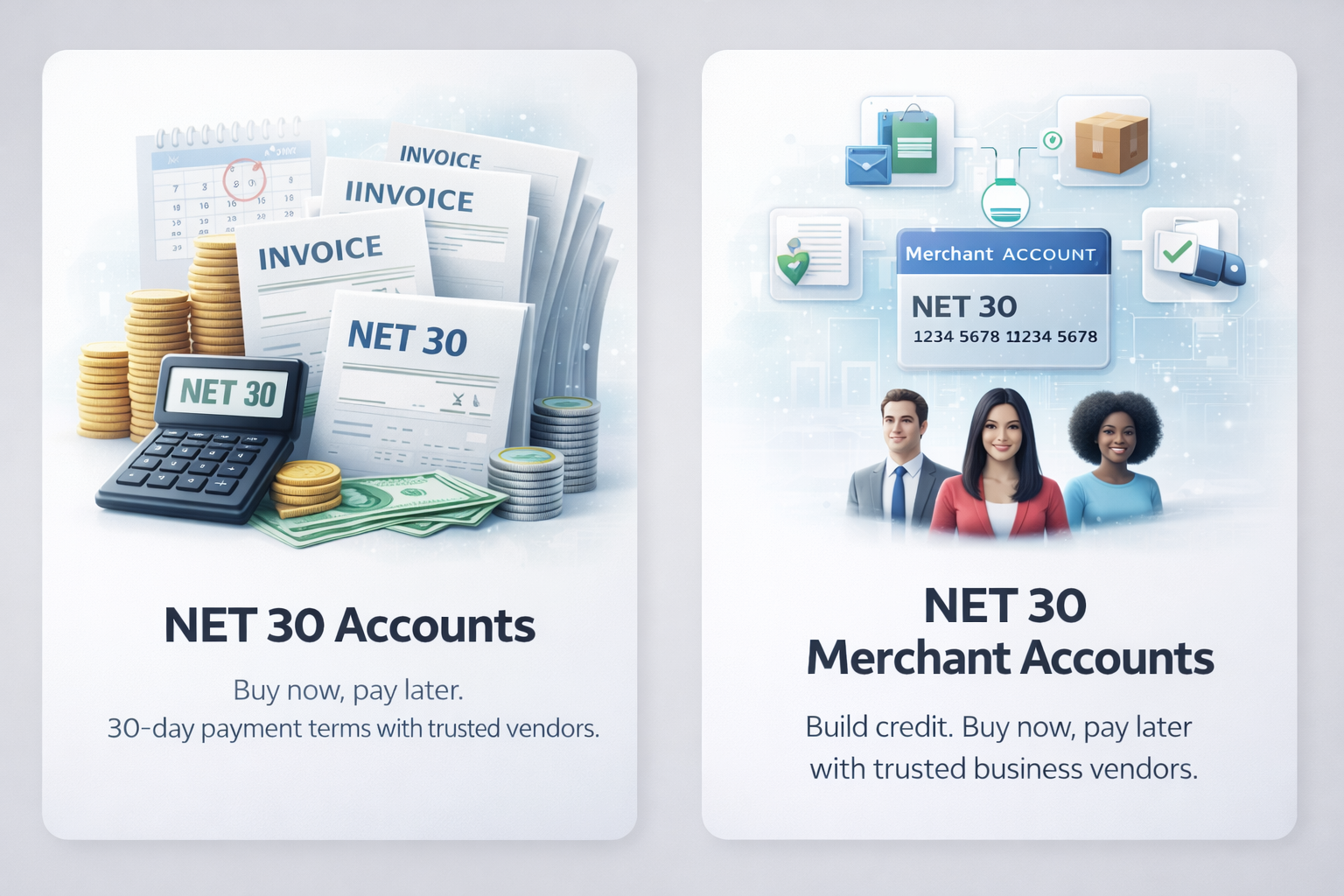
A net 30 account is a trade credit agreement between your business and a vendor. The vendor extends you a line of credit with a 30-day payment window. You place an order, receive the goods or services, and then have 30 days from the invoice date to pay in full. When you pay on time, many of these vendors report your positive payment history to business credit bureaus like Dun & Bradstreet, Experian Business, and Equifax Business.
That reported payment history is what builds your business credit score. The more on-time payments you stack up across multiple vendors, the stronger your credit profile becomes. A strong business credit profile means better loan terms, higher credit limits, and access to financing that does not require a personal guarantee.
In this guide, we will cover the five best net 30 vendor accounts for new businesses, how to apply for them, and how to use them strategically to build real business credit fast.
What Are Net 30 Accounts and How Do They Work?
A net 30 account is a type of trade credit where a vendor allows your business to purchase products or services on credit and pay the invoice within 30 days. The term "net 30" refers to the payment window — you have a net of 30 days from the invoice date to pay the full balance.
Here is how the process works in practice. You apply for a net 30 account with a vendor. Once approved, you place an order. The vendor ships the product and sends you an invoice. You then have 30 days to pay that invoice. When you pay on time, the vendor reports your payment to one or more business credit bureaus. That reported payment becomes part of your business credit file, gradually building your score.
Net 30 accounts are different from business credit cards or lines of credit in several important ways. They are typically easier to get approved for because vendors are more willing to extend trade credit to new businesses than banks are. They usually do not require a personal credit check. And they are specifically designed for purchasing business supplies, which means you are building credit while buying things your business actually needs.
The trade-off is that net 30 accounts typically come with lower credit limits than a bank credit line, and they must be paid in full within the 30-day window rather than carrying a balance. But for a new business with no credit history, they are the single most effective tool for getting started.
Why Net 30 Accounts Matter for Your Business
Building business credit is not optional if you want your company to grow. Without a credit history, your business is invisible to lenders. Net 30 accounts solve that problem by giving you a way to create verifiable payment records from day one.
Here are the key reasons every new business should open net 30 accounts as early as possible:
- Builds business credit history — Every on-time payment reported to Dun & Bradstreet, Experian, or Equifax strengthens your business credit profile. Most lenders want to see at least 3–5 trade references before approving financing.
- Easier approval than bank loans — Vendors are far more willing to extend credit to new businesses than traditional lenders. Many net 30 vendors approve businesses with no prior credit history at all.
- Separates business and personal credit — Using net 30 vendor accounts builds a credit file in your company's name, reducing your reliance on personal guarantees and protecting your personal credit score.
- Lays the foundation for bigger financing — A solid net 30 payment history is what qualifies your business for credit cards, lines of credit, equipment financing, and SBA loans down the road.
- Improves cash flow management — A 30-day payment window means you can receive inventory or supplies now and pay for them after you have generated revenue from those purchases.
Uline is one of the most recommended net 30 vendors for building business credit, and for good reason. They are a massive supplier of shipping supplies, packaging materials, janitorial products, safety equipment, and office essentials. Nearly every type of business can find something useful in their catalog.
The application process is straightforward. You can apply online at uline.com or by calling their sales team directly. You will need to provide your business name, EIN, D-U-N-S number, business address, and bank reference. Uline does not typically require a personal credit check for new accounts, making them accessible to startups.
What makes Uline especially valuable is that they report payment history to both Dun & Bradstreet and Experian Business. This means every on-time payment builds your score with two of the three major business credit bureaus simultaneously. Start with a small order, pay early if possible, and build from there.
- Pros: Reports to two bureaus, huge product selection, no minimum order, well-established reputation
- Cons: Initial credit limits may be low, shipping costs can be significant on small orders
Quill is owned by Staples and operates as a dedicated business-to-business supplier. They carry a wide range of office supplies, furniture, breakroom items, cleaning products, and technology. For businesses that need everyday operational supplies, Quill is an excellent net 30 starting point.
To apply, visit quill.com and create a business account. You can request net 30 credit terms during the signup process. Quill will ask for your business name, EIN, business address, and may request a bank reference. Approval is typically fast, and many new businesses are approved within a few business days.
Quill reports payment history to Dun & Bradstreet, which makes it a strong choice for building your PAYDEX score. The PAYDEX score is Dun & Bradstreet's business credit score, and it is one of the most widely checked scores by lenders and creditors. Every on-time payment to Quill moves that score in the right direction.
- Pros: Easy approval process, reports to D&B, fast shipping, broad product selection
- Cons: Only reports to one bureau, credit limit may start low
Grainger is a heavyweight in the industrial supply space. They carry over 1.5 million products ranging from safety equipment and tools to HVAC parts, electrical supplies, plumbing components, and facility maintenance products. If your business is in construction, manufacturing, facilities management, or any trade, Grainger is a must-have vendor account.
Grainger is one of the few net 30 vendors that reports to all three major business credit bureaus — Dun & Bradstreet, Experian Business, and Equifax Business. This makes it one of the highest-impact accounts you can open for credit-building purposes. A single on-time payment generates positive data across all three bureaus simultaneously.
To apply, visit grainger.com and set up a business account. You can request credit terms during the account creation process. Grainger may take a few extra days to review your application compared to office supply vendors, but the credit-building payoff is worth the wait. They may request two trade references if your business is new.
- Pros: Reports to all three bureaus, massive product catalog, Net 45 terms may be available, strong reputation
- Cons: More thorough application review, may require trade references, some products are industrial-specific
Crown Office Supplies has become one of the most popular starter net 30 accounts in the business credit community, and it is easy to see why. They report to all three major business credit bureaus plus CreditSafe, giving you maximum credit-building impact from a single vendor relationship.
Crown is specifically positioned for new businesses that are actively building credit. Their approval process is designed to be accessible to startups, and they understand that many of their customers are opening accounts specifically for credit-building purposes. This makes the application experience smoother than dealing with larger vendors who may have stricter requirements.
To apply, visit crownofficesupplies.com and complete the credit application. You will need your EIN, D-U-N-S number, business address, and banking information. Approval timelines vary, but many businesses report getting approved within a week. Once approved, place orders for office supplies your business actually needs, pay on time, and watch your credit file grow.
- Pros: Reports to four bureaus, startup-friendly, designed for credit builders, straightforward application
- Cons: Smaller product selection than major retailers, pricing may be higher on some items
The CEO Creative (Strategic Network Solutions) is another vendor that has built its entire business model around helping entrepreneurs establish business credit. They offer a range of business essentials including marketing materials, custom merchandise, business cards, office accessories, and promotional items.
Like Crown, The CEO Creative reports to all three major business credit bureaus plus CreditSafe. This makes them an excellent second or third net 30 account to open after you have established your first trade line. Stacking multiple vendors that report to the same bureaus accelerates your credit-building timeline significantly.
The application process is completed online. You will need your EIN, D-U-N-S number, and business banking details. Approval is generally quick for businesses that have their basic credentials in order. Once approved, order items your business can actually use — marketing materials, branded merchandise, or office supplies — and pay the invoice within 30 days.
- Pros: Reports to four bureaus, credit-builder-friendly, useful marketing products, fast approval
- Cons: Higher prices on some items, limited to business/marketing products
How to Apply for Net 30 Accounts
Before you apply for your first net 30 account, make sure your business foundation is solid. Vendors and credit bureaus will verify your business information, and any inconsistencies can delay approval or prevent your payments from being reported correctly. Here is what you need to have in place:
- Legal business entity — Your business should be registered as an LLC, corporation, or other formal entity with your state. Sole proprietorships can qualify, but an LLC or corporation carries more weight with vendors and creditors.
- EIN (Employer Identification Number) — This is your business tax ID issued by the IRS. You need this for virtually every net 30 application. You can get one for free at irs.gov.
- D-U-N-S Number — This is your unique business identifier from Dun & Bradstreet. It is free to obtain and is required by most vendors that report to D&B. Apply at dnb.com.
- Dedicated business phone number — Listed on 411 directory assistance. This is one of the first things vendors and lenders check when verifying your business.
- Business bank account — A separate checking account in your company's legal name. Most vendors require this as a bank reference on the application.
- Business address — A verifiable physical address (not a P.O. Box). This should match what is on your LLC filing, bank account, and other records.
- Business website and professional email — An email address on your own domain (you@yourbusiness.com) rather than a free Gmail or Yahoo address adds credibility.
Once your foundation is set, the application process is simple. Visit the vendor's website, create a business account, and request net 30 credit terms. Most applications ask for your EIN, D-U-N-S number, business address, and a bank reference. Approval timelines range from same-day to two weeks depending on the vendor. After approval, place a small initial order, receive the invoice, and pay it on time or early.
Tips to Maximize Your Business Credit
Opening net 30 accounts is just the first step. How you manage those accounts determines how fast and how high your business credit score climbs. Follow these strategies to get the most out of every vendor relationship:
- Pay on time, every time — This is the single most important factor. Your PAYDEX score is calculated almost entirely on payment timeliness. Even one late payment can set your progress back significantly.
- Pay early when possible — Dun & Bradstreet's PAYDEX score rewards early payments. Paying 10–15 days before the due date can push your score higher than paying exactly on the due date.
- Open 3–5 accounts within your first 90 days — Lenders want to see multiple trade references. Aim to have at least three to five active vendor accounts reporting to your credit file within your first quarter of business.
- Gradually increase order sizes — Start with small orders to establish the relationship, then increase your purchasing volume over time. Larger, consistent orders can lead to credit limit increases.
- Diversify your vendor types — Having trade lines across different categories (office supplies, industrial, marketing, technology) shows lenders that your business operates across multiple supplier relationships.
- Monitor your business credit reports — Check your Dun & Bradstreet, Experian Business, and Equifax Business reports regularly. Make sure payments are being reported accurately and dispute any errors immediately.
Common Mistakes to Avoid
Building business credit with net 30 accounts is straightforward, but there are several mistakes that can slow your progress or damage your score. Avoid these pitfalls:
- Missing the 30-day payment window — Even one late payment gets reported and can tank your PAYDEX score. Set calendar reminders and pay invoices the day they arrive if possible.
- Ordering more than you can pay off — Start small. A $50 order paid on time builds the same credit history as a $500 order paid on time. Do not overextend your cash flow trying to build credit faster.
- Not verifying that vendors report to credit bureaus — Not all vendors report payments. Before opening an account, confirm which bureaus the vendor reports to. If they do not report, the account will not help your credit score.
- Skipping the business foundation steps — Applying for net 30 accounts without an EIN, D-U-N-S number, or dedicated business phone will result in denials or unreported payments.
- Using personal information on applications — Always use your business name, EIN, and business address. Using personal details mixes your business and personal credit files, which defeats the purpose.
- Opening too many accounts at once — Stagger your applications. Opening five accounts on the same day looks suspicious. Space them out by 2–4 weeks for a more natural credit history.
Frequently Asked Questions
How long does it take to get approved for a net 30 account?
Approval timelines vary by vendor. Some vendors like Quill can approve you within 1–2 business days. Others like Grainger may take up to two weeks, especially if they require trade references. Having your EIN, D-U-N-S number, and business bank account in place before you apply speeds up the process significantly.
What credit score do I need to open a net 30 account?
Most net 30 vendor accounts do not require a personal credit check. They evaluate your business credentials — EIN, D-U-N-S number, business bank account, and business address. This is one of the biggest advantages of net 30 accounts for new entrepreneurs. Even if your personal credit is low, you can still get approved for vendor credit.
Can startups with no business credit history get net 30 accounts?
Yes. Many net 30 vendors specifically cater to startups and new businesses with no prior credit history. Vendors like Crown Office Supplies and The CEO Creative are designed for first-time credit builders. As long as you have a registered business entity, EIN, and D-U-N-S number, you have a strong chance of approval.
Do all net 30 accounts report to business credit bureaus?
No. Not all vendors report payment history to credit bureaus. Before opening an account, always confirm which bureaus the vendor reports to. The five vendors listed in this guide all report to at least one major bureau. Grainger, Crown, and The CEO Creative report to all three major bureaus.
Which net 30 vendor should I open first?
For most new businesses, Uline or Quill is the best starting point. They have straightforward applications, fast approval, and they report to major credit bureaus. Once your first account is established and paid, add Grainger or Crown to diversify your trade references across multiple bureaus.
Get Started Building Business Credit Today
Net 30 vendor accounts are the fastest, most accessible path to establishing business credit. By opening accounts with the right vendors, paying on time, and stacking multiple trade lines, you can build a strong credit profile within 90 to 120 days.
Start with one vendor — Uline or Quill are excellent first choices. Place a small order, pay the invoice early, and move on to your next account. Within three to four months, you will have a documented payment history with multiple vendors across multiple credit bureaus. That is the foundation lenders and creditors want to see.
Before you apply, make sure your business infrastructure is in place: your LLC or corporation is filed, your EIN and D-U-N-S number are active, your business phone is listed on the 411 directory, and your business bank account is open. These are the building blocks that make everything else possible.
Get Your Business Lender-Ready
TurnCom360's Lender-Ready Business Package gives you everything vendors and lenders check before approving your application — dedicated business phone with 411 listing, professional website, domain email, and NAP consistency across 30+ directories.
Get Verified →Or call (919) 390-2099 • Toll-free (888) 596-2060