
The Denial That Had Nothing to Do with Your Credit Score
You filed your LLC. You got your EIN. You opened a business bank account. You applied for a vendor account or a business credit card and got denied. The denial letter said something vague — “unable to verify business information” or “does not meet eligibility requirements.” You checked your personal credit. It was fine. You checked your business filings. Everything was current. So what happened?
What happened is that an automated verification system checked four things about your business before it ever looked at your financials: your phone number, your website, your email, and your online directory listings. And at least one of them either did not exist, did not match the others, or did not pass the system’s legitimacy threshold.
This is how modern business verification works. It is not a person reviewing your application. It is a rules engine — an automated system that cross-references your business information across dozens of data sources in milliseconds. If your phone number is a personal cell phone that is not registered on 411, the engine flags it. If your business does not have a website, the engine notes it. If your email is a Gmail address instead of a domain-based business email, the engine weighs it. If your name, address, and phone number do not match across directories, the engine sees inconsistency — and inconsistency is what fraud looks like to a machine.
You did not get denied because your business is not real. You got denied because your business does not look real to the systems that verify it.
We covered the full mechanics of how these systems work in our articles on how rules engines process applications in 0.8 seconds and how fraud graphs evaluate your phone number.
The Four Signals Every Verification System Checks
Your phone number is the first thing verification systems check — and the most consequential if it fails. The system asks: Is this a dedicated business line or a personal cell phone? Is it registered on 411 national directory assistance? Does the name on the phone match the name on the business filing? Does the phone carry verified caller authentication? Has this number been flagged for spam or associated with fraud?
If your business phone is a personal cell number, it cannot be listed on 411 as a business. It does not display your business name on outbound calls. It is not registered in the databases that lenders query. And it sends a clear signal to the verification system: this business does not have a dedicated phone line — which, to a rules engine, looks the same as a business that does not exist.
A dedicated business phone with caller name registration, 411 listing, and verified caller authentication tells the verification system that this business has a real, traceable, verifiable phone. That single signal can be the difference between approved and denied.
The verification system checks whether your business has a website and whether the information on it matches everything else. Does the site exist? Is it on a real domain (yourbusiness.com) or a free platform (yourbusiness.wixsite.com)? Does the contact information on the website match the phone number, address, and business name on your filings? Is the site active and maintained, or does it look abandoned?
No website means no digital presence — and to an automated system, a business without a digital presence is a red flag. A website with mismatched contact information is worse than no website at all, because it creates the kind of data inconsistency that verification systems interpret as potential fraud.
A professional website on your own domain with accurate, matching contact information tells the system that your business has an established online presence. The website does not need to be complicated. It needs to exist, it needs to be on your domain, and the information on it needs to match everything else.
A Gmail, Yahoo, or Outlook address on a business application is not a disqualifier by itself. But it is a data point that the verification system weighs. A business operating from contact@yourbusiness.com looks more established than a business operating from yourbusiness2024@gmail.com. The domain-based email confirms that the business owns a domain, has a website, and has invested in professional infrastructure. The free email suggests the business may be new, temporary, or unestablished.
More importantly, a domain-based email creates consistency. When your email domain matches your website domain, and your website matches your phone, and your phone matches your filings — the verification system sees a cohesive business identity. Every matching data point increases your trust score. Every mismatched or generic data point decreases it.
Your business information exists in dozens of online directories — Google Business Profile, Yelp, Bing Places, Yellow Pages, the Better Business Bureau, industry-specific directories, and 20 to 30 others that you may not even know about. Verification systems cross-reference your application data against these directories. They check whether your business name, address, and phone number (NAP) are consistent across all of them.
If Google says your address is “100 Main Street” and your filing says “100 Main St.” and Yelp says “100 Main St, Suite A” — those are three different data points that an automated system reads as inconsistency. If your phone number on your website does not match the phone number on your Google listing, the system flags it. If your business name is “Johnson Consulting LLC” on your filing but “Johnson Consulting” on your website, the system notes the discrepancy.
Individually, these mismatches seem trivial. Collectively, they create a pattern that verification systems interpret as risk. We covered exactly how this works in our article on the behavioral scoring systems that evaluate your application.
What “Lender-Ready” Actually Means
Being lender-ready does not mean having a perfect credit score. It means having a business presence that passes automated verification — every signal aligned, every data point matching, every piece of your business identity telling the same story across every platform that checks it.
Specifically, lender-ready means:
- A dedicated business phone number that is registered on 411, displays your business name on caller ID, carries verified caller authentication, and matches your filings, your website, and your directory listings.
- A professional website on your domain with accurate contact information that matches your phone number, your address, and your business name exactly as they appear on your filings.
- A domain-based business email that matches your website domain, reinforcing the consistency of your business identity.
- NAP consistency across 30+ directories — your business name, address, and phone number matching exactly across Google, Yelp, Bing, Yellow Pages, and every other directory that verification systems query.
- A Google Business Profile that is optimized, verified, and displaying accurate information that matches everything else.
When all five of these signals are aligned, the verification system sees a business that is real, established, and trustworthy. Your application passes the legitimacy check and moves on to actual financial evaluation. Without them, your application gets flagged at the first gate — and the financial evaluation never happens.
How TurnCom360 Builds Your Verified Business Presence
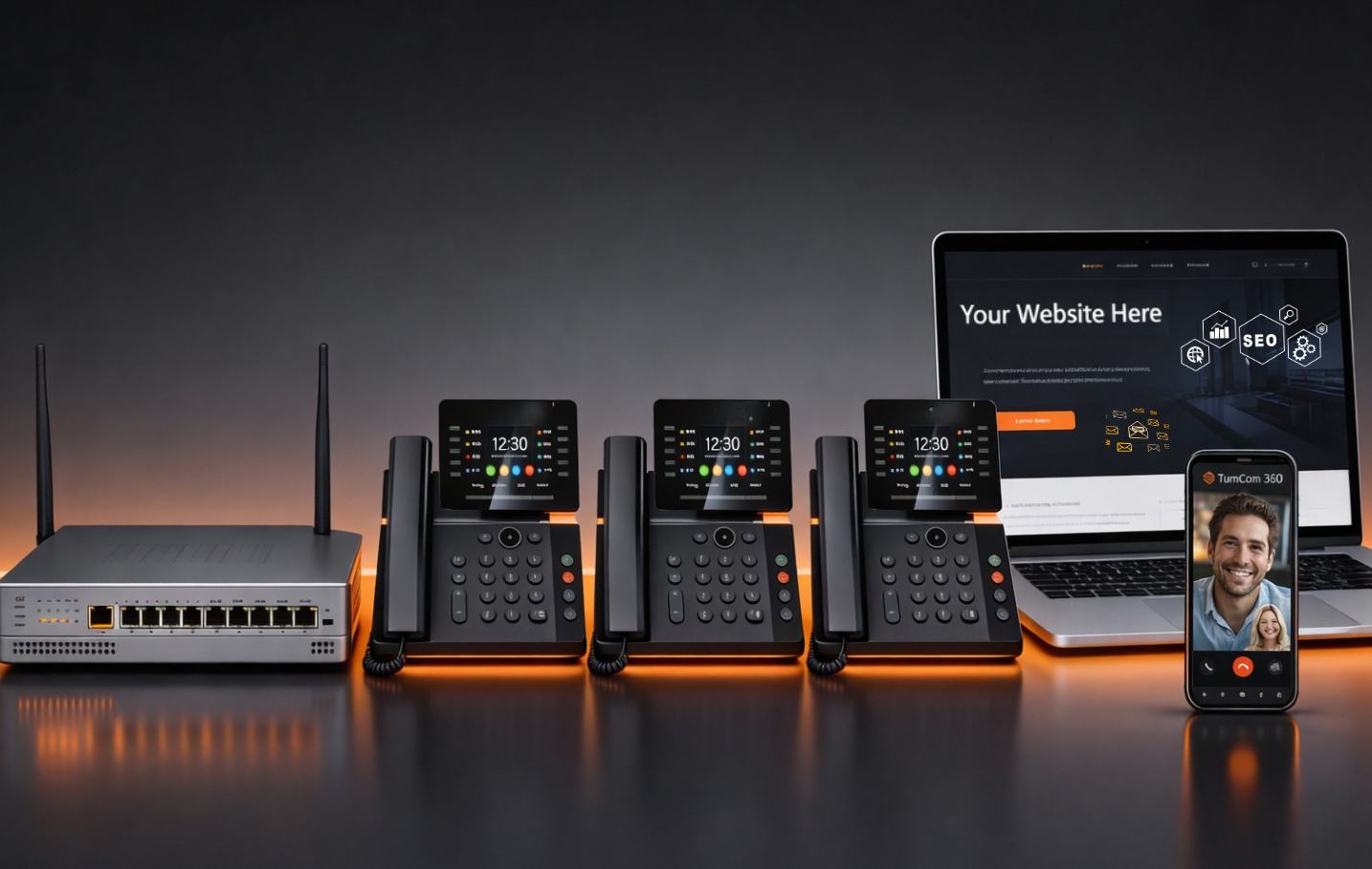
TurnCom360 does not sell you tools and expect you to build your own business presence. We build and manage the entire system — phone, website, email, and directory listings — so every piece is aligned, accurate, and verification-ready from day one.
Step 1: Professional Phone Foundation
We start with your phone because it is the anchor of your business identity. We set up a dedicated business phone number (or port your existing number), configure smart call routing, activate business caller ID with your company name, and include unlimited calling across the US and Canada. Your phone is registered on national directory databases and configured with spam prevention tools so your calls get through and your number passes verification checks.
Step 2: Digital Identity Support
We build a branded professional website on your domain with contact information that matches your phone system and your business filings exactly. We set up domain-based business email (you@yourbusiness.com) that matches your website domain. Nothing looks random. Nothing looks temporary. Every piece reinforces the others.
Step 3: Verification and Visibility
We submit your business to 30+ online directories with consistent NAP data. We optimize your Google Business Profile. We make sure that every directory, every listing, and every data source that verification systems check is showing the same business name, the same address, and the same phone number. This is where legitimacy gets confirmed — not by one listing, but by dozens of them all telling the same story.
Step 4: Ongoing Management
Business legitimacy is not a one-time project. Directories drift. Platforms update their rules. Phone systems change. Listings get overwritten by automated data aggregators. TurnCom360 monitors your business presence monthly, catches inconsistencies before they become problems, and makes updates as your business grows. One provider, one point of contact, one system that stays verified over time.
Three Levels of Legitimacy
TurnCom360 offers three packages depending on where your business is and what you need:
T360 Basic — $265/month
Best for new businesses that need to stop looking temporary. Includes professional business phone system with caller ID, smart call routing, branded website on your domain, and domain-based business email. This is your foundation — the minimum viable presence that separates a real business from a side project.
T360 Pro — $425/month (Most Popular)
Best for businesses applying for funding or scaling visibility. Everything in Basic, plus business directory listings across 30+ platforms, NAP consistency management, Google Business Profile optimization, expanded call paths, call recording and blocking, and digital footprint monitoring. This is the verification-ready package — built specifically for businesses that need to pass automated legitimacy checks before applying for credit, vendor accounts, or merchant services.
T360 Elite — $625/month
Best for businesses that want zero friction. Everything in Pro, plus advanced call flows, business SMS and shared messaging, video meetings and team presence, CRM integration, and priority support. This is the fully managed business identity — every communication channel and every verification signal handled by one team.
All three packages include a $999 one-time setup fee. All are managed by TurnCom360 on an ongoing basis — not set up once and abandoned.
The Legitimacy Checklist: Are You Ready to Apply?
Before you submit your next business credit application, vendor account request, or merchant services application, check every item on this list:
- Dedicated business phone number — Not a personal cell phone. Registered on 411. Displaying your business name on caller ID.
- Professional website on your domain — Not a free website builder URL. Contact information matches your phone and filings exactly.
- Domain-based business email — Not Gmail, Yahoo, or Outlook. Matches your website domain.
- Consistent NAP across directories — Business name, address, and phone number identical on Google, Yelp, Bing, Yellow Pages, and 30+ other platforms.
- Google Business Profile optimized — Verified, accurate hours, matching contact info, active listing.
- Secretary of State filing current — Business name and registered agent information up to date.
- D-U-N-S number active — Registered with Dun and Bradstreet with matching business information.
- Business bank account open — Separate from personal accounts, in the exact legal name of the business.
If any item on this list is missing, inconsistent, or unverified, fix it before you apply. Every gap is a flag. Every flag lowers your chances. And every denial makes the next application harder because denial history itself becomes a data point in the system.
We covered the full credibility stack — and why your phone sits near the top of it — in our article on what startups get wrong about their phone system and our guide to building business credit with Net 30 vendor accounts.
Frequently Asked Questions
Will this guarantee I get approved for business credit?
No service can guarantee approval. What TurnCom360 does is ensure that your business passes the automated verification checks that happen before your financials are even reviewed. If your application is being denied because your business does not look legitimate to verification systems — missing phone registration, no website, inconsistent listings — fixing those signals removes the barriers that were causing the denial. Your financial qualifications still matter, but they only matter if your application gets past the legitimacy gate first.
How long does it take before I should apply for credit?
We recommend waiting 30 to 60 days after your full business presence is live. This gives time for your phone number to propagate through caller databases, your directory listings to index across platforms, and your Google Business Profile to become established. Applying too early — before the data has propagated — means verification systems may not yet see your updated information.
I already have a website and a phone. Do I still need this?
Maybe. The question is not whether you have a website and a phone — it is whether they are configured correctly for verification. Is your phone registered on 411? Does your caller ID display your business name? Does your website domain match your email domain? Does the contact information on your website match your filings and your directory listings exactly? If any of those answers is no, your presence is not verification-ready, and TurnCom360 can fix the gaps.
What is NAP consistency and why does it matter?
NAP stands for Name, Address, Phone. It is the core set of data that verification systems cross-reference across dozens of directories. If your business name is spelled one way on Google, another way on Yelp, and a third way on your website, the system sees inconsistency — which looks like risk. NAP consistency means every directory shows the exact same business name, the exact same address, and the exact same phone number. TurnCom360 manages this across 30+ directories.
Why does ongoing management matter?
Because directory data drifts. Automated aggregators overwrite your information. Google updates your profile based on user suggestions. A directory reformats your address. Six months after your initial setup, half your listings may have changed without your knowledge. TurnCom360 monitors this monthly and corrects inconsistencies before they affect your verification status. Legitimacy is not a one-time project — it is an ongoing state that requires maintenance.
Is TurnCom360 a credit repair company?
No. TurnCom360 is a business technology and communications company. We do not repair credit scores, dispute trade lines, or provide financial advice. What we do is build and manage the business presence infrastructure — phone, website, email, and directories — that verification systems check before they evaluate your financials. We fix the legitimacy signals, not the credit signals. Both matter, but they are separate problems that require separate solutions.
Look Real Before You Apply
The verification system does not know you. It does not know how hard you work, how good your service is, or how many customers you have helped. It knows four things: your phone number, your website, your email, and your directory listings. It checks whether they exist, whether they match, and whether they look like they belong to a real, established business.
If they do, your application moves forward. If they do not, your application gets flagged — and you get a denial letter that says nothing useful about what went wrong.
Fix the signals before you apply. Look real to the systems that decide. And stop getting denied for problems that have nothing to do with your credit.
Get Verified Before You Apply
TurnCom360 builds and manages your complete business presence — phone, website, email, and directory listings — so every verification system sees a real, consistent, trustworthy business. Starting at $265/month.
See Lender-Ready Packages →Or call (919) 390-2099 • Toll-free (888) 596-2060